
Read
Nov 20, 2025
This article explores the psychological depths of personal growth, offering actionable strategies to overcome subconscious blocks.
Most people set annual goals and wonder why they never materialize. Twelve months is too long. Your motivation fades. Distractions accumulate. Momentum dissipates. But compress that timeline to 90 days—and something neurological shifts. The deadline becomes real. Your brain activates. Urgency focuses effort. Suddenly, extraordinary results become possible. This article reveals the precise framework top achievers use to compress a year’s worth of progress into just 12 weeks.
Ninety days is the optimal timeframe for transformation. Here’s why:
Three months feels simultaneously immediate (creating urgency) and achievable (not impossibly distant). Your brain can visualize 90 days clearly. A year feels abstract. A week feels too short to accomplish anything significant. Ninety days hits the psychological Goldilocks zone.
Neuroscience reveals that it takes approximately 66 days for a new habit to become automatic. A 90-day sprint extends just beyond this threshold, allowing habits to solidify while momentum remains high. You build sustainable change, not just short-term intensity.
Quarterly thinking aligns with how businesses operate—financial quarters, performance reviews, strategic planning cycles. This cultural alignment means accountability structures, support systems, and resources naturally organize around 90-day cycles.
Research on goal achievement shows that motivation naturally peaks at the beginning of a sprint and at the finish line. Ninety days is short enough that motivation can sustain throughout, yet long enough to accomplish genuine transformation.
Vague goals produce vague results. Before you move, you must see exactly where you’re going.
The Clarity Process:
1. Define Your One Primary Goal
Not five goals. Not ten initiatives. One primary goal. This is the achievement that would make the next 90 days wildly successful. Everything else is secondary.
Ask yourself: “If I accomplish only one thing in the next 90 days, what would make the greatest impact on my life/business/health?”
Examples of powerful 90-day goals:
Launch a new product or service
Achieve a specific revenue target
Lose 20 pounds and establish consistent exercise
Complete a manuscript or creative project
Establish a new skill at intermediate proficiency
Build a new habit and make it automatic
Achieve a professional milestone or certification
2. Define Your Success Metrics
Your goal must be measurable. Not “get healthier”—”lose 15 pounds and run a 5K in under 28 minutes.” Not “build my business”—”acquire 50 new clients and generate $25,000 revenue.”
Write your goal with specific, measurable criteria. This clarity creates focus and allows you to track progress.
3. Identify Your “Why”
Clarity extends beyond the goal itself to the reason behind it. Why does this matter to you? What will achieving this unlock? How will your life be different?
Your “why” is your fuel during weeks 6-8 when motivation naturally dips.
The Clarity Output:
By the end of week one, you should have:
One clear, measurable primary goal
Three supporting sub-goals (if needed)
Specific success metrics
A compelling “why” written down and reviewed daily
Now that you know where you’re going, you must map the path. This phase transforms your big goal into manageable milestones.
The Milestone Architecture:
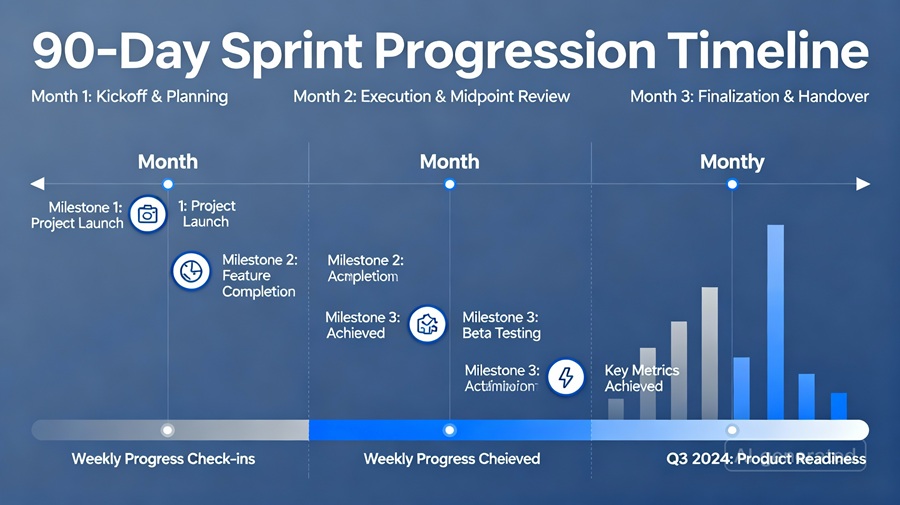
Divide your 90-day goal into three 30-day milestones.
Each milestone represents a major progress checkpoint. This structure prevents overwhelm and creates natural accountability cycles.
Example: 90-Day Goal: Launch a Digital Product
Milestone 1 (Days 1-30): Product design complete, sales page drafted, email sequence written
Milestone 2 (Days 31-60): Product recorded/created, sales page finalized, pre-launch campaign begins
Milestone 3 (Days 61-90): Product launched, first 100 customers acquired, feedback loop established
Break Each 30-Day Milestone Into Weekly Targets
Each week should have 3-5 specific deliverables—actions that move you toward your milestone.
Week 1 of Milestone 1:
Research competitor products (define positioning)
Outline product curriculum
Create initial sales page framework
Schedule three customer interviews
This granularity prevents procrastination and creates daily clarity.
Identify Critical Path Activities
Not all activities are equally important. Identify the 20% of actions that produce 80% of results. These are your critical path activities—the non-negotiable work that must happen weekly.
Example: For product launch, the critical path might be:
Product creation/recording
Sales page copywriting
Email list building
Protect these activities fiercely. They’re your priority.
The Milestone Breakdown Output:
By end of week two, you have:
Three 30-day milestones with clear deliverables
Weekly targets for each milestone
Identified critical path activities
A visual roadmap (timeline, checklist, or project management system)
This is where most frameworks fail: execution without accountability. The 90-Day Sprint prevents this through structured weekly accountability.
The Weekly Accountability System:
1. Weekly Planning Session (Every Monday)
Fifteen minutes. Every Monday morning, review your week ahead:
What are this week’s three critical actions?
What obstacles might arise?
What support or resources do I need?
How does this week move me toward my milestone?
This ritual anchors your focus and prevents drift.
2. Daily Micro-Commitments
Each morning, identify your “non-negotiable three”—three actions that, if completed, move you meaningfully toward your goal. These are small enough to complete despite interruptions.
Example: If your goal is writing a book:
Non-negotiable three: Write 1,500 words, outline next chapter, research one source
Completing your daily three creates psychological momentum and daily wins.
3. Weekly Accountability Review (Every Friday)
Thirty minutes. Review:
Did I complete my weekly targets?
What worked? What didn’t?
What did I learn?
What will I adjust next week?
Progress toward my 30-day milestone?
This isn’t self-judgment; it’s data collection. You’re gathering information to optimize your sprint.
4. Partner or Public Accountability
Accountability multiplies when it’s external. Options:
Accountability partner: Weekly call with someone pursuing their own 90-day goal. You share progress, obstacles, and commitments.
Public commitment: Share your goal and weekly progress with your audience (social media, email list, community).
Accountability group: Join or create a group pursuing 90-day sprints together.
Research shows that public commitment increases goal achievement by 65%.
5. Momentum Maintenance Rituals
Weeks 1-3: Momentum is naturally high. Use this to establish habits and build early wins.
Weeks 4-6: Motivation naturally dips (this is expected). Combat this through:
Reviewing your “why” daily
Celebrating small wins
Shifting to easier sub-goals temporarily
Increasing accountability frequency
Weeks 7-9: Second wind often emerges. You can see the finish line. Push hard here.
Weeks 10-12: Final sprint. Intensity increases. Focus narrows to essential activities only.
The final phase is often skipped, yet it’s crucial for sustainable transformation.
The Completion Process:
1. Celebrate Your Achievement
Don’t rush to the next goal. Pause and acknowledge what you’ve accomplished. This isn’t vanity; it’s neurological. Celebration releases dopamine, reinforcing the neural pathways you’ve built.
2. Analyze Your Results
Review your success metrics:
Did you hit your goal? If yes, by how much? If no, how close?
What were the three most effective actions?
What obstacles emerged? How did you overcome them?
What would you do differently?
This analysis becomes your wisdom for future sprints.
3. Extract the Habits
Any habits you built during the sprint—morning workouts, writing time, customer calls—should be integrated into your ongoing life. Don’t let them disappear.
4. Plan Your Next Sprint
Ninety days complete. Now what? You have options:
Deepen the same goal: Continue the momentum with phase two of the same objective
Adjacent goal: Move to a related goal that builds on your progress
Different domain: Shift to a completely different life area (business to health, for example)
The framework repeats: Clarity → Breakdown → Execution → Completion.
Goal: Launch a coaching business and acquire 20 paying clients in 90 days
Starting point: Employed full-time, no coaching experience, no client list
30-Day Milestone 1: Complete certification, identify niche, create website, reach out to 50 people for discovery calls
30-Day Milestone 2: Refine positioning based on discovery calls, create service packages, close first 5 clients
30-Day Milestone 3: Build referral system, create content, close remaining 15 clients
Result: 23 paying clients acquired, $12,000 revenue generated, coaching business launched successfully
Key success factor: Sarah increased her accountability frequency to 3x weekly during weeks 4-6 when motivation dipped. She also identified that discovery calls were her critical path activity and protected them fiercely.
Goal: Lose 25 pounds, run a half-marathon, establish consistent exercise habit
Starting point: Sedentary, poor nutrition, no running experience
30-Day Milestone 1: Establish gym routine (4x weekly), improve nutrition, build to 2-mile run
30-Day Milestone 2: Consistent training (5x weekly), nutrition locked in, build to 6-mile run
30-Day Milestone 3: Peak training, run half-marathon, integrate new habits into lifestyle
Result: Lost 24 pounds, completed half-marathon in 2:08, now maintains fitness habits 18 months later
Key success factor: Marcus used a training partner and public commitment (shared progress on Instagram). The social accountability was crucial for consistency, especially during weeks 6-8.
Goal: Write and publish a 60,000-word non-fiction book
Starting point: Ideas but no writing habit, no publishing experience
30-Day Milestone 1: Outline complete, write 15,000 words, research 60% complete
30-Day Milestone 2: Write 25,000 more words, complete research, establish writing habit
30-Day Milestone 3: Complete final 20,000 words, edit, prepare for self-publishing
Result: Manuscript completed and published on Amazon, 300+ copies sold in first month
Key success factor: Elena’s non-negotiable three were strict: “Write 2,000 words, edit previous day’s content, update outline.” Nothing else mattered until these were done. This protected her creative energy.
Beyond time management, optimize your energy. Schedule deep work during your peak cognitive hours. Schedule administrative tasks during energy troughs. This simple shift compounds dramatically.
Constraints force creativity. Limit yourself: “I have only 5 hours weekly for this goal” or “My budget is $1,000.” Constraints force you to prioritize ruthlessly and be innovative.
Weekly reviews aren’t optional—they’re your optimization mechanism. Treat them as experiments. Try something new, measure results, adjust. This rapid iteration accelerates progress.
Success rarely happens in isolation. Build in:
Weekly accountability partner calls
Mastermind group participation
Professional coaching or mentoring
Community engagement (Facebook group, Slack channel, forum)
You set a goal that requires 40 hours weekly, but you only have 10 available.
Solution: Resize your goal or extend your timeline. It’s better to achieve an appropriately-sized goal than fail at an oversized one.
You lose momentum halfway through.
Solution: This is expected and temporary. Increase accountability frequency, celebrate small wins, review your “why” daily, and temporarily shift to easier sub-goals to rebuild momentum.
You keep adding new initiatives, diluting your focus.
Solution: Write down anything that wants to become part of your sprint. Capture it for “after 90 days.” During the sprint, protect your primary goal ferociously.
You spend weeks planning and never start executing.
Solution: 70% planning is sufficient. Get to execution by end of week two. Learning happens through action, not planning.
Ninety-day sprints aren’t isolated events. They’re the building blocks of your annual results.
Four strategic 90-day sprints in different domains:
Q1: Business goal (new product, revenue target)
Q2: Health goal (fitness, nutrition habit)
Q3: Skill goal (learn new capability, certification)
Q4: Relational goal (deepen connections, community building)
After one year of four focused sprints, you’ve fundamentally transformed four major life areas. After three years, you’re unrecognizable from where you started.
This is how extraordinary results accumulate: not through years of vague effort, but through quarters of focused, accountable, milestone-driven sprints.
This week:
1. Identify your primary goal: What one achievement would make the next 90 days wildly successful?
2. Define success metrics: How will you measure this goal’s completion?
3. Write your “why”: Why does this matter? How will your life change?
4. Build your support structure: Who will be your accountability partner? What system will you use to track progress?
5. Create your first milestone: What must happen in the first 30 days?
Then—begin. Not next week. Not after you plan more. This week. Action before perfection.
Ninety days from now, you’ll be astonished at what’s possible when you compress time, clarify focus, and build accountability.
Your extraordinary results are 12 weeks away.

Written by
Life & Leadership Coach helping individuals unlock their full potential.